


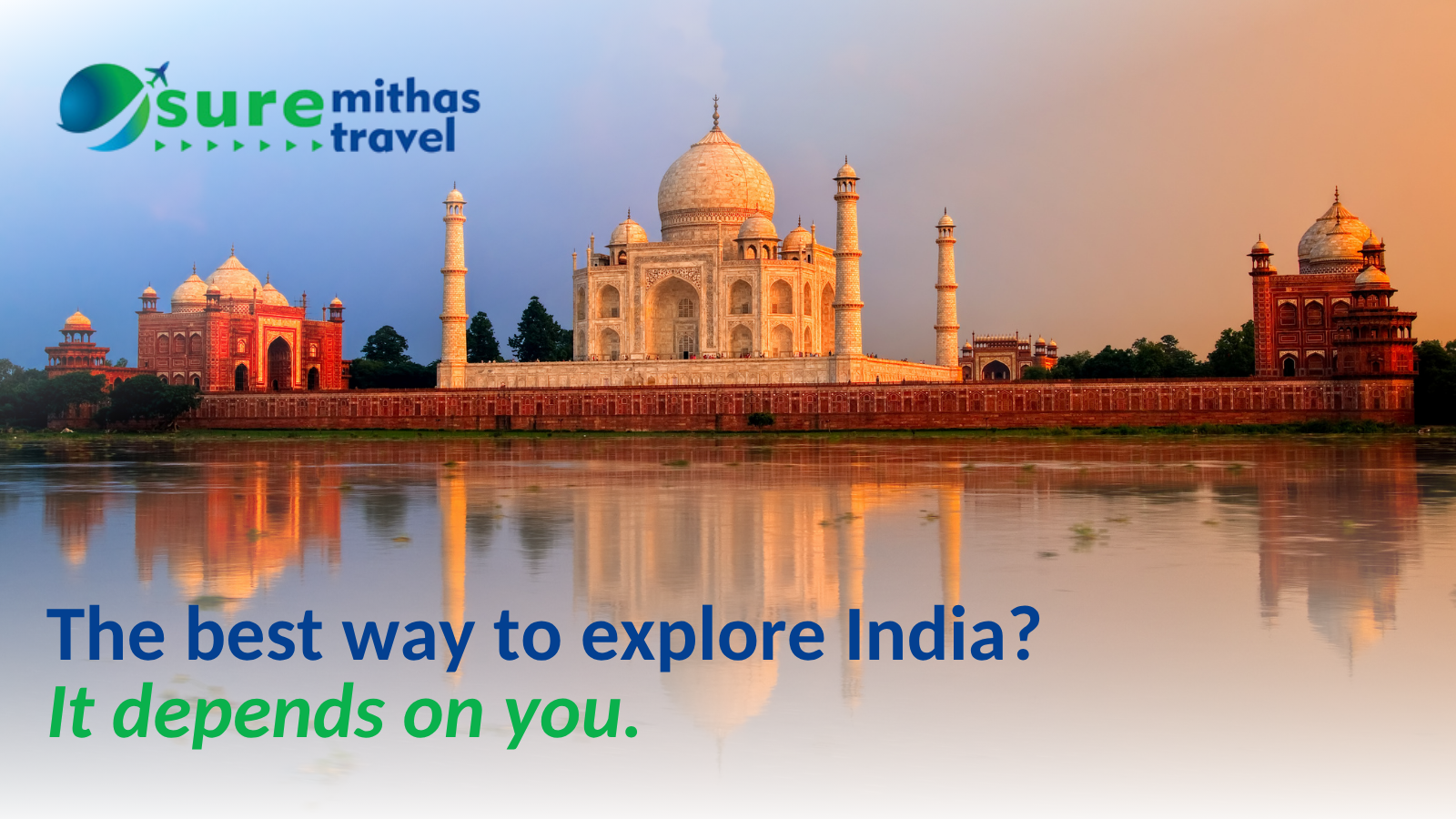
India rewards you when you give it time. A week in Rajasthan feels very different from a week in Kerala, and even a train ride can become part of the experience. A rushed itinerary can leave you spending more time getting somewhere than enjoying it.
There is no single best way to see India. Choose a region that interests you, pick the right way to get around, and give yourself more time than you think you need.
Table of Contents
ToggleWhat is the best way to explore India?
The best way to explore India is to combine different types of transport and focus on one or two regions rather than trying to see the whole country. Trains work well for longer journeys, private cars offer flexibility within a region, and domestic flights save time when destinations are far apart.
Trying to cover too much ground is an easy way to rush an India trip. Distances are huge, and time spent travelling is time you could be spending at your destination. Two regions done properly will usually be more enjoyable than five cities in a week.
How to travel around India
The best option depends on the route, the distance and how you want to experience the journey:
- Train travel is one of the most memorable ways to move through India. The rail network connects most major destinations, and an overnight train can save you a night in a hotel. Book ahead for popular routes, particularly for higher-class compartments.
- A private car and driver is a good choice for exploring a region at your own pace. In Rajasthan, for example, you can stop at forts and villages between Jaipur, Jodhpur and Udaipur instead of following a train timetable. It also makes it easier to plan around the places you want to see.
- Domestic flights make sense when the alternative is 12 hours or more overland. India has a well-developed airline network connecting major cities. If your trip combines northern and southern India, flying between regions can save several days.
Transport | Best for | When to skip it |
Train | Intercity journeys, overnight travel, the experience of moving through India | Very long distances where flying saves days |
Private car and driver | Regional sightseeing, moving at your own pace, rural areas | Long intercity distances between major cities |
Domestic flight | Covering large distances efficiently | Short hops where the trip itself is the point |
Local transport | Getting around cities, markets, local areas | Long distances or tight itineraries |
Which region of India should you visit?
Where you go will shape your trip more than how you get there. Each region of India has its own landscapes, food, culture, and pace.
- Northern India: Delhi, Agra and Varanasi
Most first-time visitors start here. Delhi is busy and full of history, Agra is home to the Taj Mahal, and Varanasi offers an experience unlike anywhere else. Seven to ten days gives you time to see all three without constantly packing and unpacking.
- Rajasthan
If forts, palaces, colourful markets, desert landscapes and great food appeal to you, Rajasthan is a great choice. Jaipur, Jodhpur, Udaipur and Jaisalmer each have their own character, and the region pairs well with Delhi and Agra.
- Kerala
Kerala offers a slower side of India. The backwaters around Alleppey, tea plantations in Munnar, spice gardens in Thekkady and beaches around Varkala are best enjoyed without packing too much into each day.
- Goa
Goa is an easy place to slow down. Its beaches, Portuguese-influenced towns and relaxed pace make it a popular addition to a longer trip, especially before your flight home.
- The Himalayan regions
Ladakh, Himachal Pradesh and Uttarakhand attract travellers who want mountain scenery, trekking, Buddhist monasteries and high-altitude landscapes. These regions need more planning, but offer a very different side of India.
How many days do you need in India?
There is no perfect number of days, but giving yourself enough time makes a big difference.
Trip length | What works |
7 days | Focus on one compact region: the Golden Triangle (Delhi, Agra, Jaipur) or Kerala alone |
10–14 days | Combine the Golden Triangle with Rajasthan, or Kerala with Goa |
2–3 weeks | Explore two or three regions, with enough time in each to settle in |
3+ weeks | Cross-region trips, the Himalayas, or a deeper stay in one area |
The Golden Triangle, connecting Delhi, Agra and Jaipur, is one of the easiest seven-day itineraries for first-time visitors. The three cities are well connected by road and rail, and each has enough to keep you busy for two or three days. It is also a good introduction to India’s history and architecture.
Experiencing India beyond the famous sites
The famous sights deserve their place, but some of the experiences you remember most happen between them. Give yourself time to eat, wander through a market or simply watch the world around you.
Food is a good example. Jaipur’s spiced street food tastes very different from Kerala’s coconut curries, while Goa has its own seafood traditions. Try eating beyond hotel restaurants and ask locals for recommendations.
Markets offer another window into everyday life. The spice markets of Old Delhi, textile bazaars in Jaipur, flower markets in Mumbai and tea markets around Munnar are all worth making time for.
A good local guide can change the way you experience a historic site. At places such as Fatehpur Sikri or Hampi, a guide can bring the history and stories behind what you are seeing to life. Mithas Travel can connect you with experienced local guides.
If your dates allow, consider planning around a festival. Diwali, Holi, the Pushkar Camel Fair and the Jaisalmer Desert Festival can be busy, but they offer a memorable glimpse of Indian culture.
Which India experience suits your travel style?
The best itinerary is the one that suits the way you actually like to travel.
- Couples and honeymooners often enjoy Rajasthan’s heritage hotels and Kerala’s houseboat stays. Both offer beautiful scenery and a slower pace. A sunrise visit to the Taj Mahal is another experience worth making time for.
- Families usually benefit from a well-paced itinerary, private transport and manageable distances. Rajasthan works particularly well because the forts and wildlife parks offer plenty to see.
- Luxury travellers will find a strong heritage hotel scene in India. In Rajasthan, former palaces such as Umaid Bhawan in Jodhpur and the City Palace in Udaipur make the accommodation part of the experience.
- Adventure travellers should look north. Ladakh, Spiti Valley and Himachal Pradesh offer trekking routes, mountain scenery and a more challenging side of India.
- Food and culture lovers are better off slowing down. Spend a week in Rajasthan rather than rushing through four states or take a cooking class in a Keralan village.
When is the best time to visit India?
The best time to visit India depends on where you are going. Northern India and Rajasthan are usually most comfortable between October and March. April and May can be very hot, while the monsoon runs from June through September.
Kerala is most comfortable between October and February. Its southwest monsoon runs from June to September, bringing lush scenery, though travel can be more difficult. Goa is best from November to February.
The Himalayan regions are mainly accessible from May to October, with some high-altitude passes opening only during summer.
Choose your region first, then work backwards to find the right season.
The Himalayan regions are mainly accessible from May to October, with some high-altitude passes open only in the summer months.
The more useful approach is to choose your region first, then work backwards to find the right season.
How to explore India without rushing
Spend at least two nights in each destination if you can. One night is rarely enough to get beyond the logistics of arriving, checking in and leaving.
Allow extra time for road journeys. A five-hour drive can easily become seven once you factor in traffic, stops, and delays.
Leave a morning or day unscheduled if you can. India has a way of filling the gaps, and an unplanned morning can become one of the best parts of the trip.
Try not to combine more than three or four major cities in a week. Beyond that, the trip can start to feel like a series of arrivals and departures.
Avoid combining more than three or four major cities in a single week. Beyond that, the trip starts to feel like a series of arrivals.
Should you book a tour or travel independently?
Both approaches can work well in India. The better choice depends on how comfortable you are with planning, unfamiliar systems and the unexpected.
Independent travel gives you freedom, but it also means you manage transport, reservations, and unfamiliar systems yourself. Train bookings, for example, can be difficult if you have never used the IRCTC system.
A specialist travel agency lets you choose your destinations and pace while handling reservations, connections and other logistical details.
Group tours offer a fixed structure and an on-the-ground guide, and they suit first-time visitors who prefer travelling with others.